
Launching the 2024 Regional Index on Violence against Women and Girls
The Regional Observatory on Violence against Women and Girls (VAWG) hosted by EuroMed Feminist Initiative in Amman, has developed the Regional Index on VAWG, which includes a set of indicators under seven categories to follow up and support the implementation of policies and measures to combat VAWG in Middle East and North Africa Region (MENA).
The 2021 Regional Index included seven countries - Algeria, Egypt, Jordan, Lebanon, Morocco, Palestine and Tunisia, who scored and presented the results at a high-level conference held in Amman.
The 2024 Regional Index was widened to nine countries, including Iraq and Syria. It was reviewed at the Regional Expert Roundtable in November 2024, in Baghdad, in light of the new developments and forms of VAWG. It was scored by all countries, and the Regional Observatory combined the results.
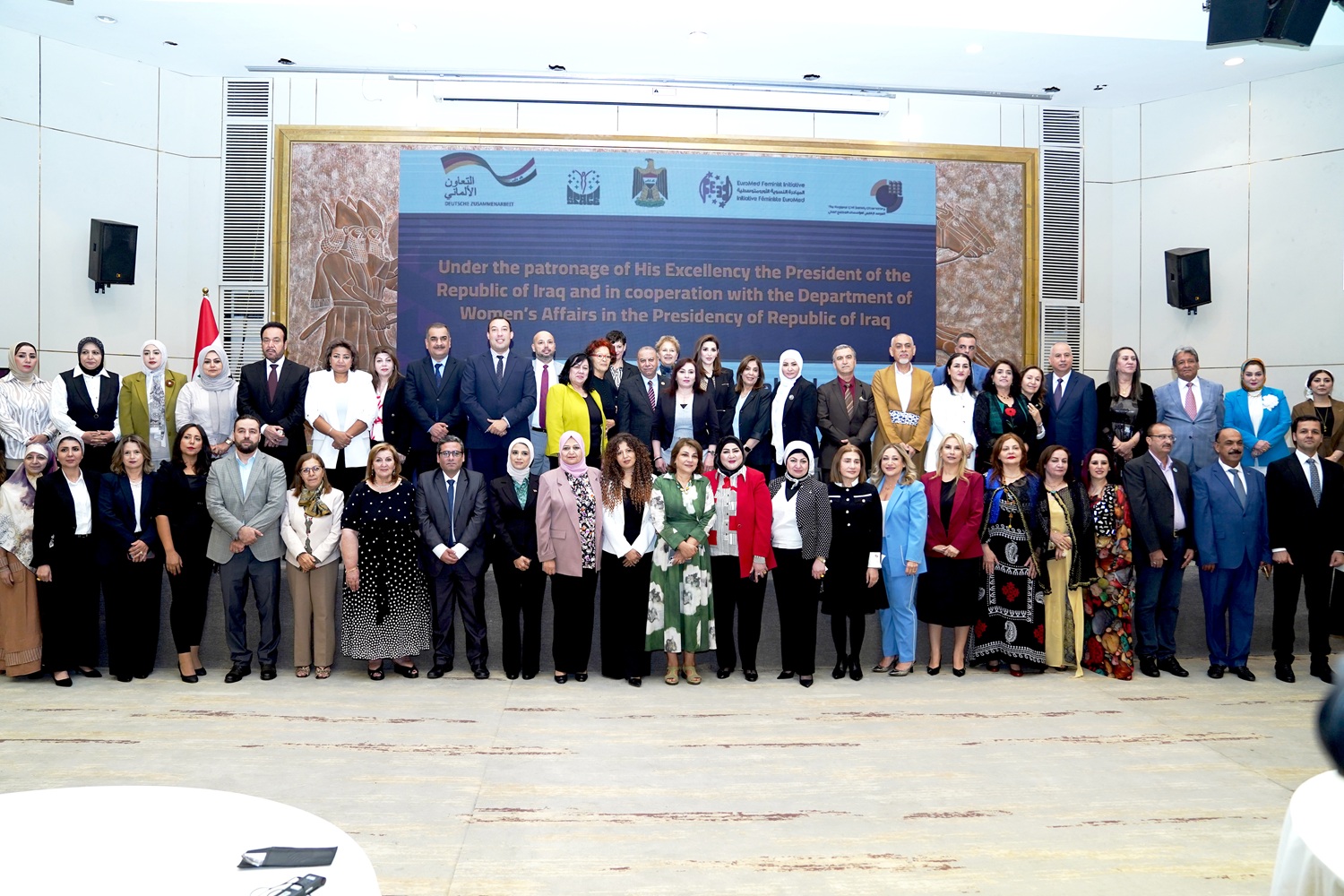
The launching of the 2024 Regional Index on VAWG took place on 22-23 of September 2025 in Baghdad, organised under the patronage of His Excellency the President of the Republic of Iraq by EuroMed Feminist Initiative and Regional Observatory on VAWG in partnership with the Department of Women´s Affairs at the Presidency of Iraq, as part of the project “Combating VAWG in Iraq – Enhancing Cross Sector Cooperation”, as a part of the “Strengthening Participation, Peaceful Coexistence, and Equality in Iraq (SPACE”) programme, funded by the German Federal Ministry for Economic Cooperation and Development (BMZ), supported by Deutsche Gesellschaft für Internationale Zusammenarbeit (GIZ) GmbH.
In her opening remarks, Ms Hana Gorgis, Director General of the Department of Women's Affairs in the Presidency of Iraq, stated: “The Department of Women’s Affairs at the Presidency of the Republic is actively working to combat VAWG and to coordinate with governmental and international partners to reduce this phenomenon, which is crucial for building a stable and prosperous Iraq that guarantees women a safe and free life.”
Dr. Amir Al-Kenani, Legal Advisor to the President of Iraq confirmed that “Iraq’s participation in the Regional Index is a key pillar, to support Iraq proactive participation in developing strategies, including the formulation of a strategy to combat violence against women and the preparation of the National Action Plan for the implementation of United Nations Security Council Resolution (UNSCR) 1325 on Women, Peace, and Security. The establishment and existence of dedicated women’s offices in all ministries´ departments, as well as the National Women’s Department in the Prime Minister’s Office, along with specialized committees on women in the Council of Representatives, alongside the active participation of numerous CSOs has helped addressing women’s issues and adopting positive, affirmative measures such as the women’s quota system, ensuring at least 25% representation of women in parliament, reaching 30% in the Kurdistan Region of Iraq, as well as women’s representation at various other levels.”
Dr. Shahba Ahmed Hussein, Advisor on Women’s Affairs to the Prime Minister of Iraq, in her opening remarks underlined that “It is important to address this phenomenon through the national strategies and the establishment of the Supreme Council for Women under the Prime Minister’s Office. The continued provision of care and support will strengthen further the political, economic, and moral empowerment of women.”
Ms. Fink Shafiq, speaking on behalf of Dr. Khanzad Ahmed Secretary-General of the High Council for Women and Development in the Kurdistan Regional Government underlined that “Kurdistan Region’s inclusion in the 2024 Regional Index represents a significant achievement. The regional indicators provide a tool for monitoring and evaluating performance in cooperation with relevant government authorities to ensure the best services for women and girls. Non-governmental organizations play a crucial role of in tracking and assessing government activities based on these indicators. The relevant authorities need to establish effective mechanisms for implementing the Regional Index. The Kurdistan Regional Government should allocate a dedicated budget to combat VAWG.”
H.E. Ms. Mona Al-Khalili, Minister of Women in the State of Palestine, in her speech emphasized that the Regional Index on VAWG represents an important tool for building monitoring and documentation systems and strengthening protection mechanisms. Addressing the audience on behalf of Palestinian women, she highlighted the multiple forms of violence they face in Gaza and the West Bank, including killings, displacement, forced eviction, and the systematic targeting and destruction of West Bank camps, which has resulted in the displacement of thousands. “In this context, the launch of the 2024 Regional Index on VAWG in Arab countries, is a significant step toward strengthening monitoring, documentation, and accountability. Developing reliable indicators is a key entry point for ensuring accountability and linking findings to relief and reconstruction efforts.”
Mr. Jamal Sahimi, Head of the Women’s Empowerment Department, Morocco, delivered a statement on behalf of the Minister of Solidarity, Social Integration, and Family, emphasizing that VAWG constitutes a major barrier to comprehensive development and family cohesion, making it a priority that requires political will and effective legislation. He explained that Morocco works on combating violence through a series of reforms guided by the King’s directives and aligned with the broader national reform agenda, among which the key achievement is the 2018 Law to Combat Violence Against Women, which established a detailed conceptual framework to define practices considered VAWG, including forced marriage, sexual violence, harassment, and incest, while imposing stricter penalties for these offenses. He further emphasized the importance of strengthening cooperation among government institutions, private sectors, and civil societies, and adopting a multi-dimensional strategy to enhance women’s economic participation and combat all forms of violence.
Ms. Lilian Halls French, Policy Advisor of the EuroMed Feminist Initiative (EFI), underlined in her opening remarks that the conference aims to address the issue of VAWG, recognizing it as one of the most prominent human rights violations, with impacts extending beyond women to the society as a whole. She commended the significant efforts made to ensure the success of the Index, thanking Mr Kenani and Ms. Gorgis for their exceptional partnership, as well as the German Agency for International Cooperation (Deutsche Gesellschaft für Internationale Zusammenarbeit (GIZ) GmbH) and all conference participants and supporters.
Mr. Axel Klaphake, Country Director of the German Agency for International Cooperation (GIZ), in his remarks, emphasized the significance of this historic occasion — the launch of the 2024 Regional Summary Index on VAWG — as part of a broader program aimed at promoting participation, peaceful coexistence, and equality in Iraq, and explained that the project was implemented by GIZ on behalf of the German Government, which provided generous financial support for its completion.
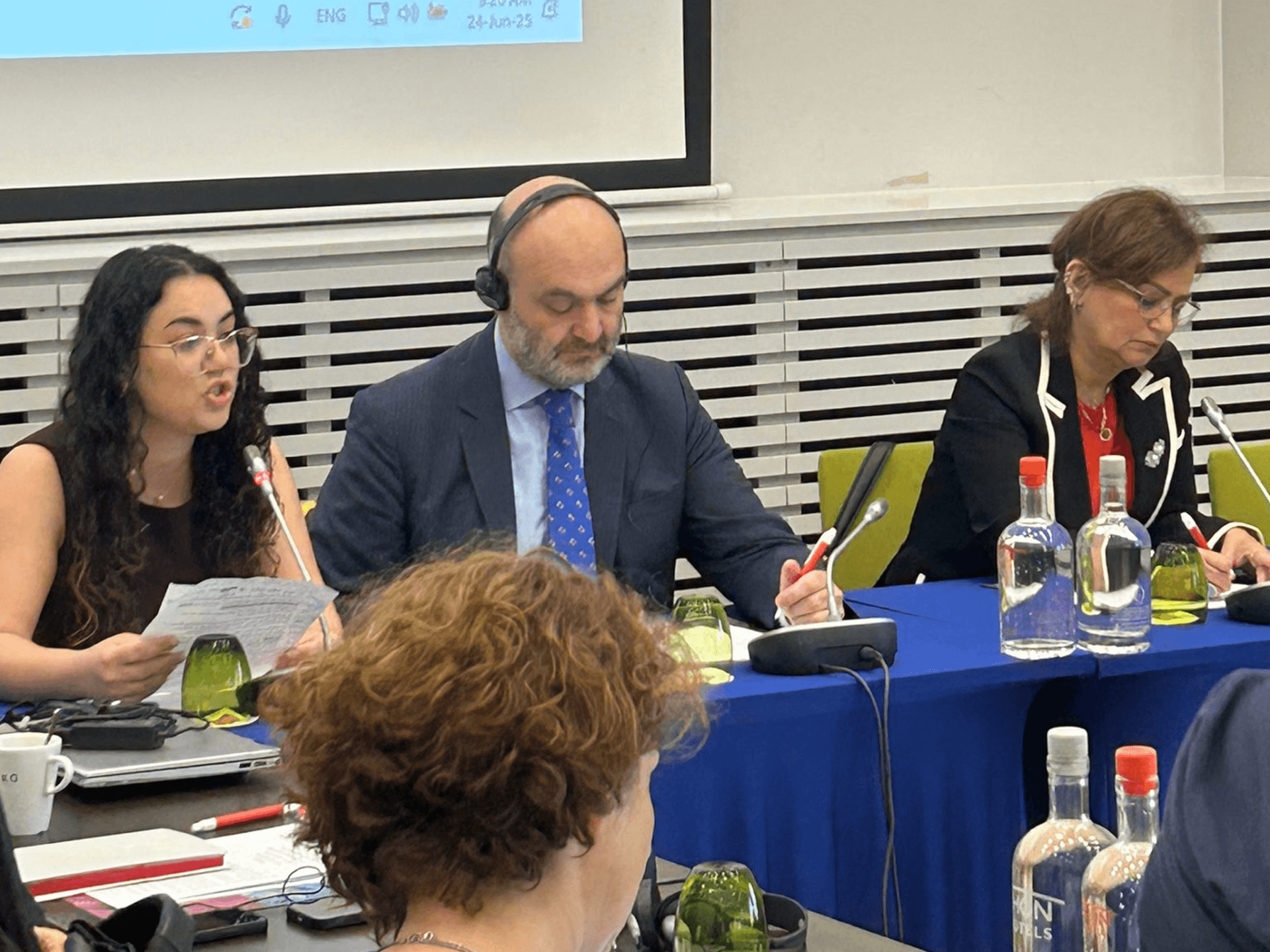
Over 100 participants, ministers and representatives from governments, institutions and civil society from the 9 countries of the Index gathered to present and hear the scoring results of the 2024 Regional Index on VAWG, to discuss main challenges and develop recommendations for concrete actions to be taken to enhance policies, preventive measures and services for victims in order to improve the everyday life of women.
Date
Category
News
"")